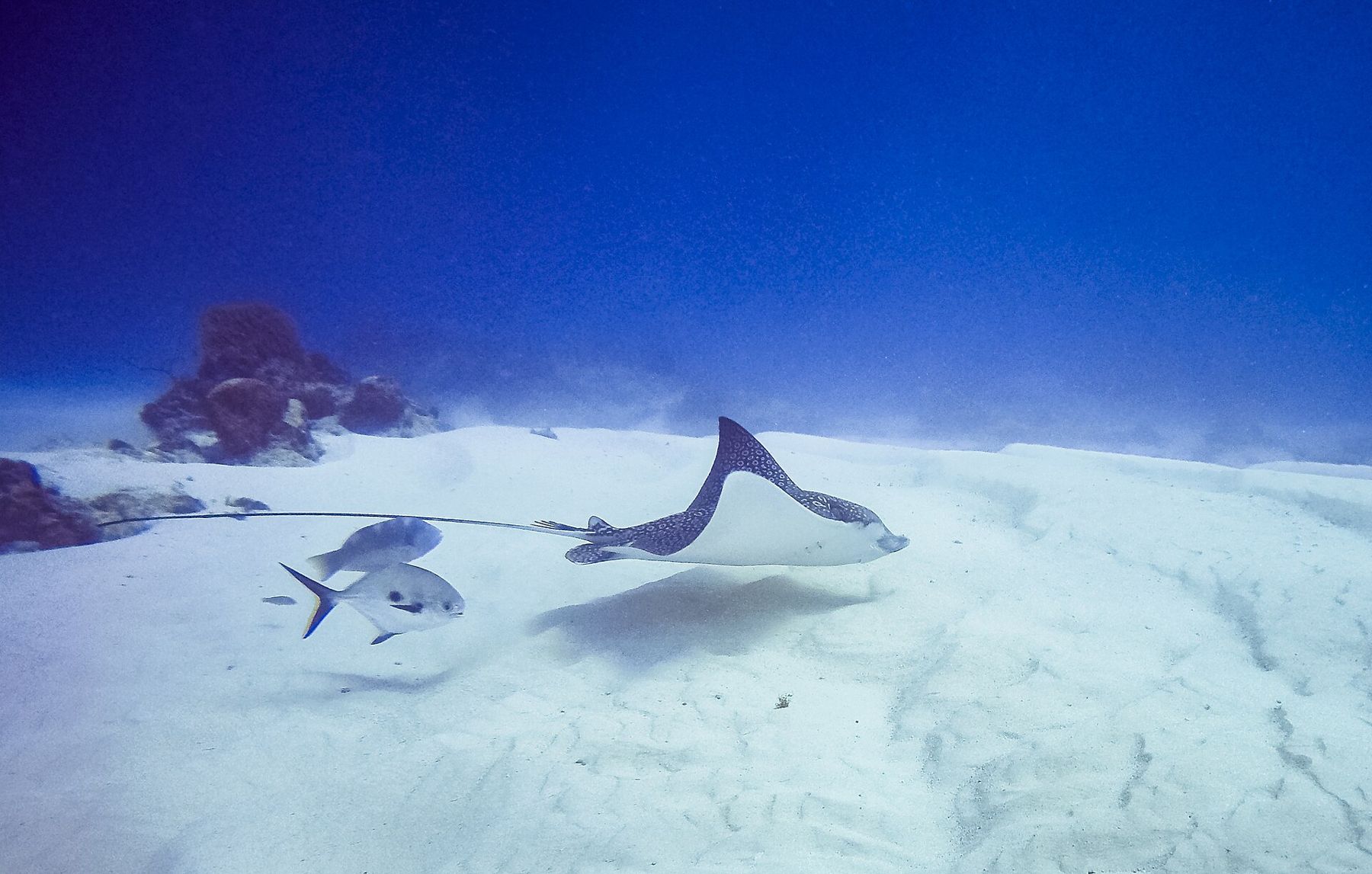
Off Cozumel the boat does not wait at an anchor while you dive. It drops you up-current, follows your bubbles, and picks you up wherever you surface, sometimes a kilometre or more from where you started. This is drift diving, and on Cozumel's west and south sides it is the normal way to dive. Done well, it is the most relaxed diving there is: you barely kick, and the reef slides past.
This entry explains how a drift dive is usually run, step by step. Every operator and every guide has their own routine, so follow your briefing over anything written here. The current changes daily, and the captain and dive guide decide where the group goes in, how long it stays down, and whether a site is diveable at all.
Why the water moves
Cozumel lies in the path of a strong ocean current that flows northward through the channel between the island and the mainland. Close to the reefs, that flow is shaped by the island's shoreline and the reef edge, so it speeds up around points, slows in bays and sometimes reverses or swirls near the bottom. On a typical day along the west side, the current runs roughly north, and dive boats plan their drops with that in mind.
Strength varies from a gentle drift to a fast ride. Some sites, such as the walls at Santa Rosa or the deeper reefs to the south, are known for stronger flow at times. Gentler drifts are more common on the shallow reefs off town, which is why new divers often start there. The current is also why visibility is often so good: it carries clear oceanic water along the reef and sweeps silt away.
The briefing and the drop
Before each dive the guide briefs the group: the site, the expected direction and strength of current, the planned maximum depth and dive time, the turn-around pressure, hand signals, and what happens if anyone is separated. Listen closely. This is where you learn whether the drop is a negative entry and where the group will gather.
A common technique is a backward roll from the side of the boat, with the whole group going in close together on a signal from the captain. Because the boat is moving with the current rather than anchored, everyone needs to be ready at the same moment: mask on, regulator in, hand on mask and weight belt or BCD. Some guides ask for a negative entry, meaning you roll in with the BCD empty and descend straight away so the group does not scatter at the surface. Others prefer a quick buoyant regroup and a slow descent together. Do what the briefing says.
Once down, the group settles near the reef edge. The guide sets the pace and the depth. Your job is to stay close.
It helps to prepare on the boat before the drop is called. Set up and check your gear early, analyse your gas if you are diving nitrox, and know where your fins and mask are. When the captain gives the standby signal, sit on the side with everything in place and wait. A diver still pulling on a fin when the others roll in starts the dive several metres behind, and in current that gap grows quickly.
Riding the current
The key skill in a drift dive is not to fight the water. Trim flat, keep your arms in, and let the current carry you. Along the coral towers of Palancar, that means flying past the ridges rather than trying to stop at each one. Use small fin movements to steer and to hold your position relative to the group, not to swim against the flow. If you want to look at something, look as you pass; swimming back up-current burns air fast and leaves you behind.
Buoyancy matters more than usual. A wall or a coral tower can appear suddenly, and a diver who is too heavy can be pushed into the reef. Stay a comfortable distance above and off the coral, and never grab the reef to stop. Gloves are not allowed in the Cozumel marine park, for good reason: they make it too easy to hold on. If you need to pause, the guide may lead the group into the lee of a coral head or down into a sandy patch where the flow is weaker.
Watch your depth, your air and your computer as the reef passes. Currents can carry you over deeper sections without much warning. Dive within your training and your computer's limits, and signal the guide early if anything changes.
If you drift away from the group, you drift away from the boat.
Staying with the group
The single most important rule on a drift dive is to stay with your buddy and the group. The guide usually carries a surface marker buoy or a float on a line, which the boat captain follows. If you drift away from the group, you drift away from the boat.
If you do become separated, the standard advice is simple: look around briefly, ascend slowly while still looking, make your safety stop, and on the surface inflate your own surface marker buoy, often called a safety sausage, so the boat can see you. Stay calm; you are moving with the same current as the group. A whistle helps, and some divers carry a signal mirror or a small light. Ask before the dive what the operator expects you to carry and how they handle separations.
Keep the ascent controlled and the safety stop unhurried, following your training. On a reef that slopes into deep water, it is easy to start drifting upward or downward without noticing, so check your computer often.
The pickup
At the end of the dive, the guide signals the ascent and the group comes up together, usually after a safety stop in midwater. The guide sends the buoy up, or inflates it, and the boat approaches the group. Stay together on the surface with your BCD inflated and your mask on. Do not swim toward the boat unless asked; the captain will bring the boat to you and approach from the side that keeps the propeller clear.
Climbing back aboard is usually by a ladder at the stern or side. You may be asked to pass up weights, then fins, before climbing. On choppy days this is the hardest part of the dive, so take your time and follow the crew's instructions.
The surface interval follows, with the boat moving to the next site while you rest, drink water and note the dive in your log. Record the site, the depth, the time and the strength and direction of current. Over several days you will start to see how the water behaves, and why the reefs here look the way they do.
Who shot these frames
- Matthew T Rader, CC BY-SA 4.0
- Sharon Hahn Darlin, CC BY 2.0
- Paul Harrison, CC BY-SA 4.0
- Sharon Hahn Darlin, CC BY 2.0