Every reef in this logbook belongs to one long system. From the northern tip of the Yucatán Peninsula near Isla Contoy, a band of coral runs south past Cancún, Puerto Morelos, Cozumel and the Riviera Maya, along the coast of Belize, past Guatemala, and on to the Bay Islands of Honduras. It is usually called the Mesoamerican Reef, and at roughly a thousand kilometres it is one of the longest reef systems on Earth and the largest in the Western Hemisphere.
This entry gives the outline: how the reef is shaped along the Mexican coast, which corals build it, what lives on it, and the plain facts about bleaching and disease. It is background for the site entries rather than a dive plan, but the conditions in the header are typical for the Mexican stretch.
The shape of the reef
Along most of the Mexican Caribbean coast, the reef is a fringing reef. It grows close to shore and parallel to it, often a few hundred metres out, with a shallow lagoon between the reef crest and the beach. You can see this clearly at Puerto Morelos, where surf breaks on the crest within sight of the town. Behind the crest, the lagoon floor is sand and seagrass with scattered coral heads. In front of it, the reef slopes away into deeper water.
Cozumel is different. The island sits off the mainland across a deep channel, and its reefs grow along the edge of a shelf on the sheltered west and south sides. There the reef takes the form of coral ridges, towers and walls that drop steeply into the channel, swept by a current that usually runs northward. Those reefs are covered in the Cozumel entries, from Palancar to Santa Rosa.
Further south, off Belize, the system becomes a true barrier reef, separated from the coast by a wide lagoon, with atolls offshore. The whole chain is linked by currents that carry coral larvae and fish larvae from one stretch to the next, which is one reason damage in one place matters elsewhere.
The corals that build it
Stony corals lay down the limestone skeleton of the reef. Each colony is made of many small polyps, living in partnership with microscopic algae in their tissue that supply much of their food through photosynthesis. That partnership is why reef-building corals need clear, warm, sunlit water, and why they are sensitive when the water gets too hot.
A few groups are easy to learn:
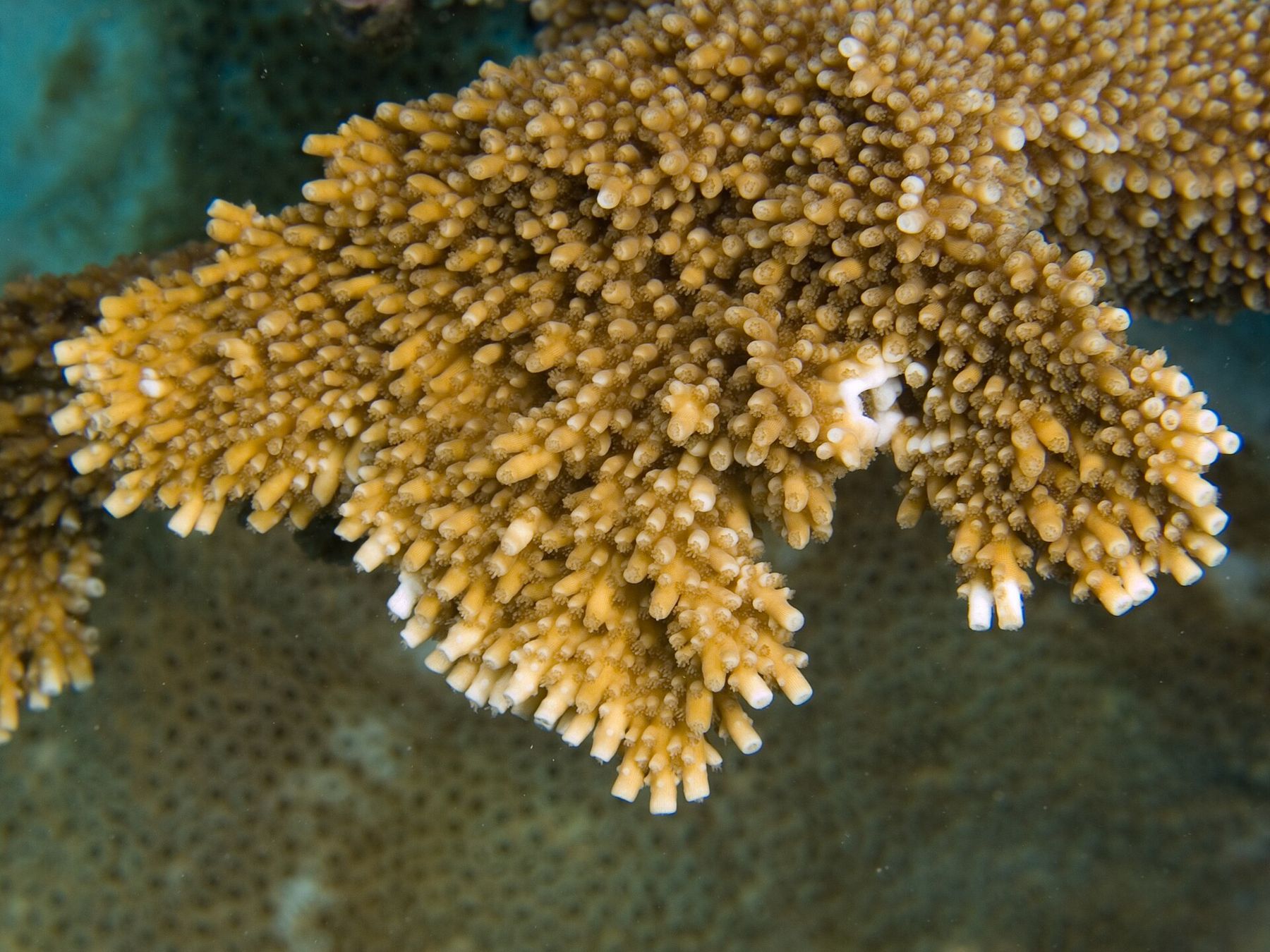
- Elkhorn coral grows in broad, flattened branches like antlers, in the shallowest, roughest water near the crest. It once formed thick stands across the Caribbean and has declined sharply since the 1980s.
- Staghorn coral is its relative, with thinner, rounder branches. It too has declined heavily and is the focus of many restoration projects.
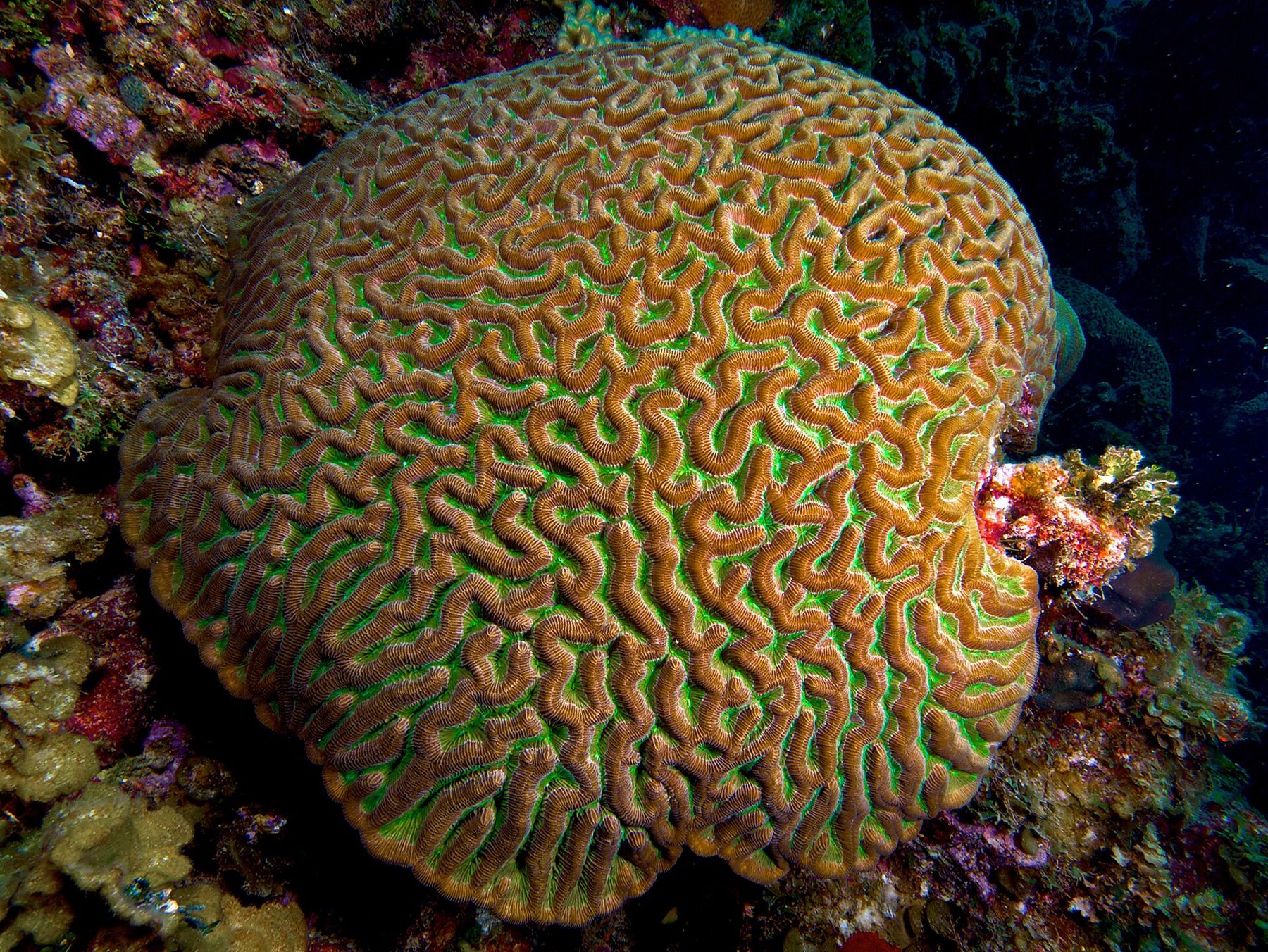
- Brain corals form rounded boulders with winding grooves across the surface. They grow slowly and can be very old.
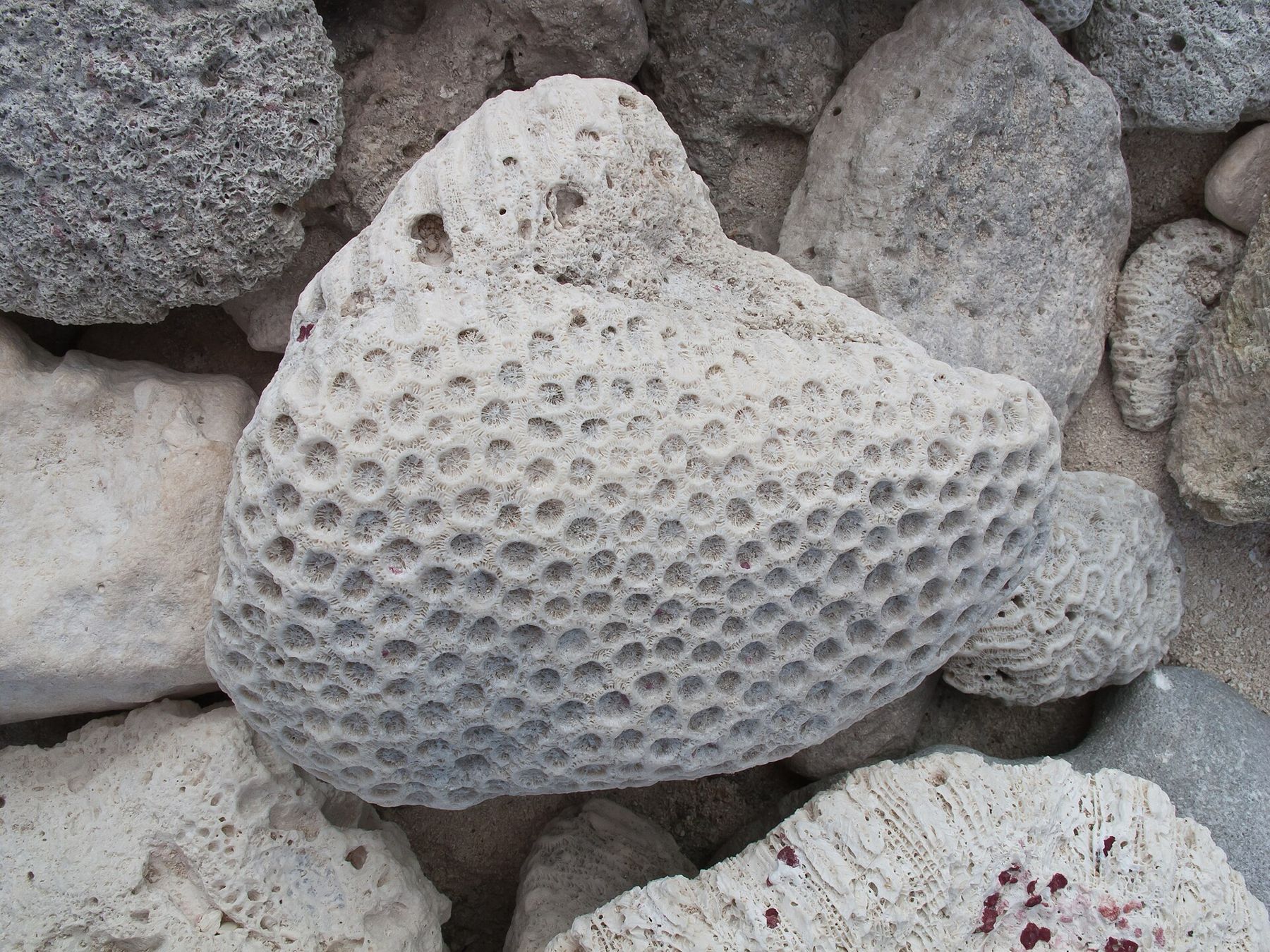
- Star corals build mounds, plates and columns studded with small round polyps, and do much of the structural work on deeper reefs.
- Pillar coral grows in upright fingers; it was among the species hit hardest by recent disease.
Soft corals such as sea fans and sea rods sway in the current alongside them, and sponges in barrels, tubes and vases add colour. On the sand around the reef, seagrass beds act as nurseries for young fish.
Every reef in this logbook belongs to one long system.
What lives on it
The reef supports hundreds of fish species, from tiny gobies to large groupers. Parrotfish scrape algae from dead coral and grind it into sand. Surgeonfish and tangs graze in roving groups. Snappers and grunts school in the shade of overhangs. Angelfish, butterflyfish, triggerfish and wrasses work the reef face.
Larger animals pass through. Green and hawksbill turtles feed on seagrass and sponges. Spotted eagle rays glide along the reef edge, and southern stingrays rest on the sand. Nurse sharks sleep under ledges by day. Cozumel adds a fish found almost nowhere else, the splendid toadfish, which has its own entry. Seasonal visitors pass through as well, such as whale sharks off the northern coast in summer, though they belong to open water more than to the reef itself.
Bleaching and disease, told plainly
When water temperatures stay above what corals tolerate for weeks at a time, the coral expels the algae living in its tissue. The colony turns pale or white, which is why it is called bleaching. A bleached coral is not dead, and if the water cools in time it can regain its algae and recover. If the heat lasts too long, it starves and dies. The Caribbean has seen several major bleaching episodes, including severe marine heatwaves in recent years, and parts of this reef have bleached during them.
The second pressure is disease. Stony coral tissue loss disease was first recorded off Florida in 2014 and reached the Mexican Caribbean in 2018. It spreads quickly and kills tissue on many species of stony coral, especially brain, star and pillar corals, leaving bare white skeleton behind. It has changed the look of many reefs along this coast, including in Cozumel.
Other pressures add up: runoff and wastewater from coastal development, overfishing of the grazers that keep algae in check, sargassum seaweed piling up near shore in heavy years, storms that break coral, and physical damage from anchors, fins and hands.
Why it is still worth the dive
None of this means the reef is gone. Fish life remains rich, large animals still pass along the reef edge, and many coral colonies have survived both heat and disease. Restoration projects grow fragments of staghorn and elkhorn coral in nurseries and replant them. Marine parks limit anchoring, fishing and the number of visitors at the busiest sites, and the rules you follow on every dive here, described in the marine park entry, are part of that effort.
What divers and snorkellers can do is mostly about restraint. Keep fins and hands off the reef. Do not stand on coral, even in shallow water. Choose a mineral sunscreen or, better, cover up. Do not feed fish. If a site is closed to let it rest, accept the closure. These are small things, multiplied by the many thousands of people who visit this coast every year.
Reefs change over seasons and years, and what you see on any dive is one moment in a long story. Log what you see, with the date and depth, and if you return, compare. The difference between two entries a few years apart can teach more about this reef than any brochure.
Who shot these frames
- Nhobgood Nick Hobgood, CC BY-SA 3.0
- Luis Miguel Bugallo Sánchez (Lmbuga), CC BY-SA 3.0
- Nhobgood, CC BY-SA 3.0
- Luis Miguel Bugallo Sánchez (Lmbuga), CC BY-SA 3.0