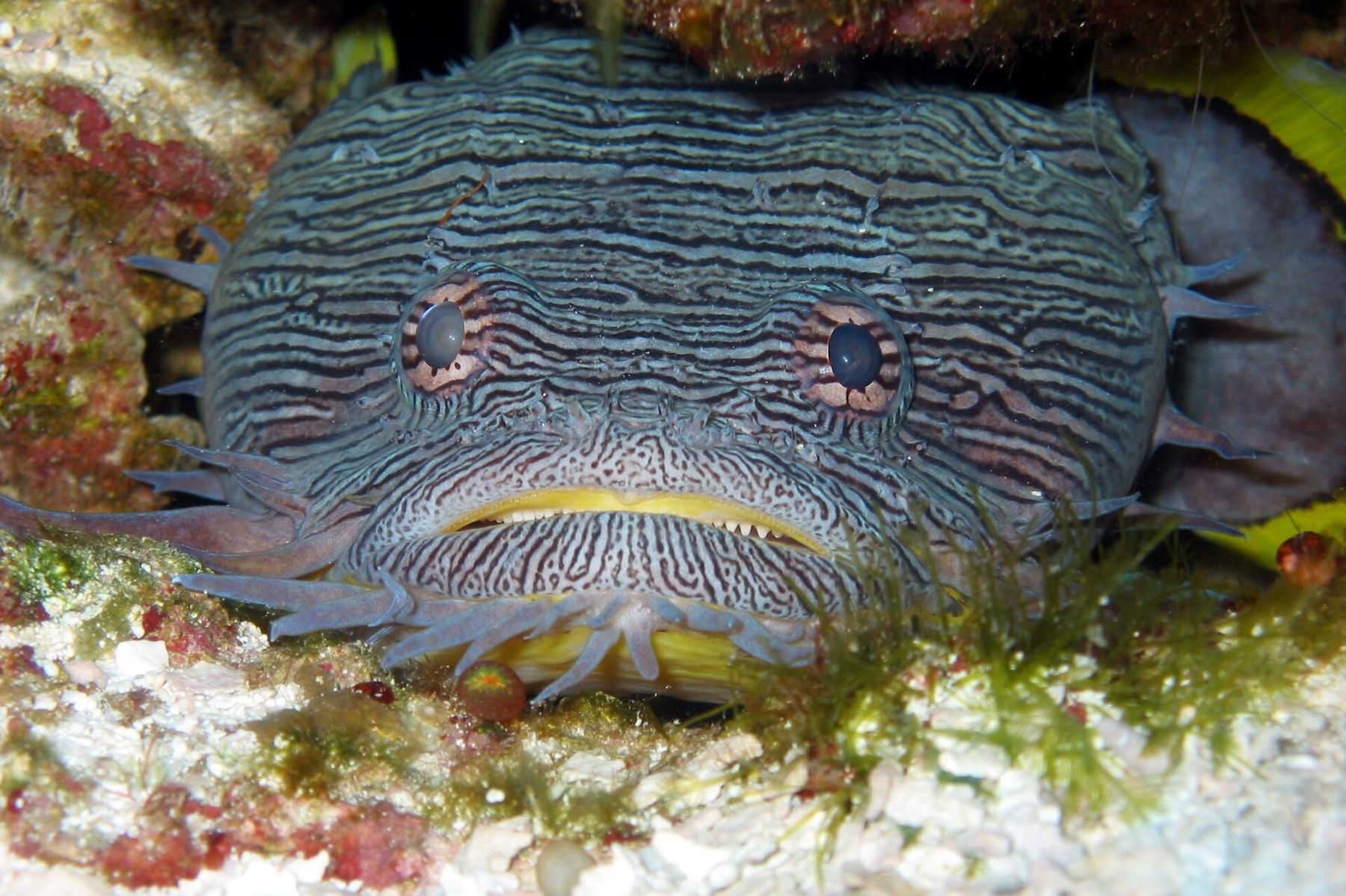
Look under a ledge on almost any Cozumel reef and you may find a pair of eyes looking back: a flat, broad head with wavy dark and pale stripes, a wide mouth fringed with small barbels, and fins edged in bright yellow. This is the splendid toadfish, Sanopus splendidus, and the island is close to the only place in the world where divers see it. For many visitors it is the fish they most want to log.
This entry covers what the toadfish is, where and how to look for it, and the bigger residents of the same reefs: eagle rays, turtles and nurse sharks. Sightings are never guaranteed. Animals move, and the current and the guide decide where the group goes.
A fish found almost nowhere else
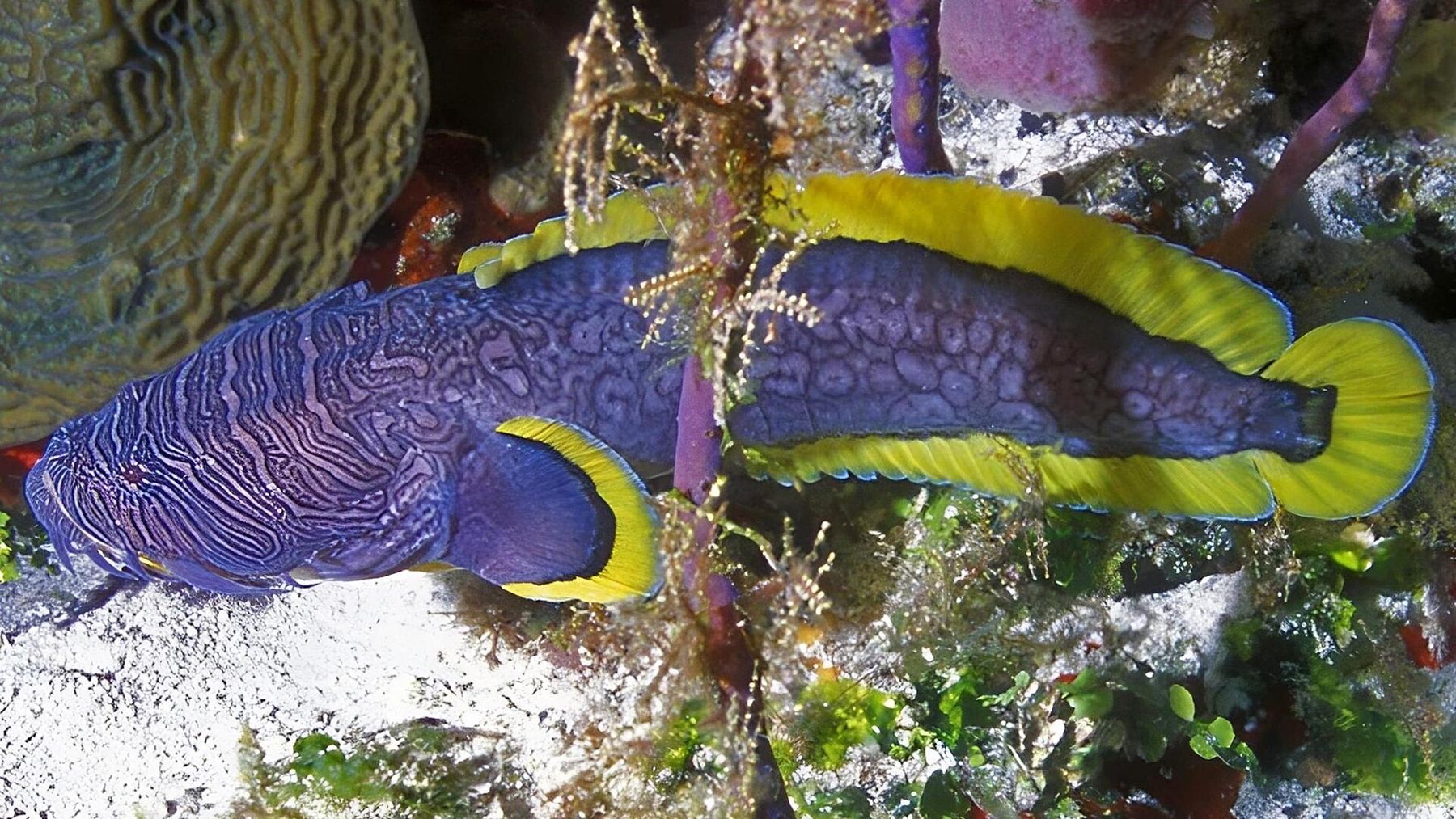
Toadfish are a family of bottom-dwelling fish found in many seas, most of them drab and well camouflaged. The splendid toadfish is the exception. Its body is dark, often bluish or purplish, crossed by pale wavy lines on the head; its fins carry vivid yellow edges. It grows to around a forearm's length and spends most of its life under ledges, in crevices and in holes in the reef.
It is considered endemic to Cozumel, meaning it is known from the island's reefs and very few, if any, places beyond. That makes it a symbol of the island and a good reason to look after the reef it depends on. Few fish anywhere have such a small range.
How to find one
The toadfish is shy, mostly nocturnal, and stays tucked into its hole. Divers usually see only its head and the front of its body. The trick is to look carefully under overhangs and into crevices at the base of coral heads, rather than at open reef.
Your ears may find it before your eyes. Male toadfish make a loud grunting or croaking call, sometimes described as a boat whistle, to attract females and defend territory. On a quiet dive you may hear it as a low, repeated hum. Following the sound rarely leads straight to the fish, but it tells you one is near.
Guides on Cozumel know where individual toadfish tend to live and often point them out. A small dive light helps you see into dark crevices; shine it at the edge of the hole rather than straight into the fish's eyes, and keep the beam brief. Do not reach in, poke or try to coax the fish out. Hold position off the reef with good buoyancy, look, and move on.
Toadfish are found on many of the island's reefs, including the gentler sites off town covered in the entry on the reefs off San Miguel, where shallow depths and mild current give you more time to look.
Spotted eagle rays
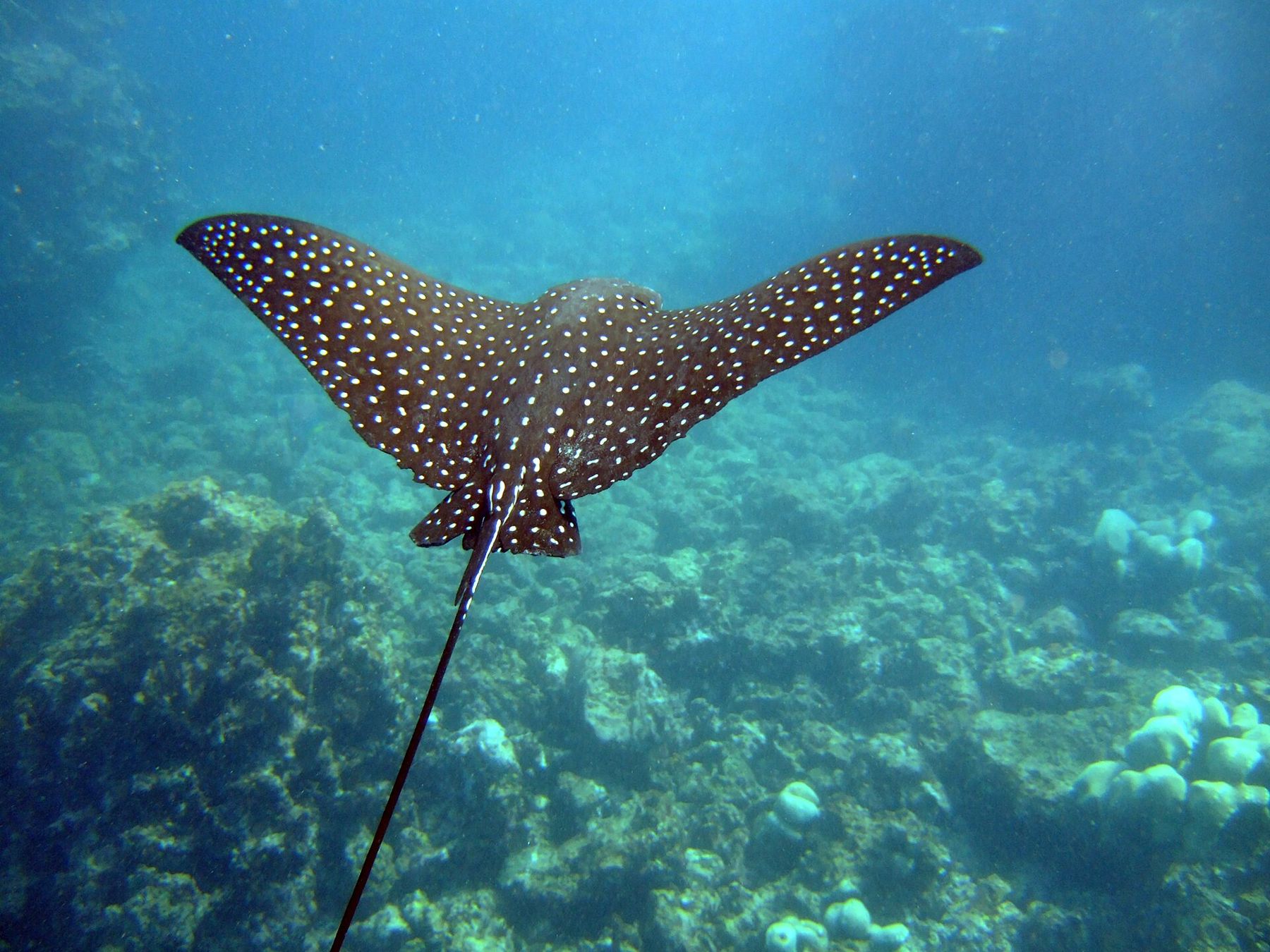
Spotted eagle rays are among the most graceful animals on the reef. They have dark backs covered in white spots, long whip-like tails and pointed wings that they flap slowly as they glide. Sometimes they travel alone, sometimes in small groups. They often cruise the edge of the reef or over sand, rooting for shellfish with their snouts.
They are wary of divers and tend to keep a distance. The best way to see one is to stay still, breathe slowly and let it pass. Chasing an eagle ray only drives it away. In Cozumel they are seen on many sites, from shallow sand to deeper walls; the deep reefs around Colombia are among the places they are often reported.
Turtles
Hawksbill and green turtles are both seen on Cozumel's reefs. Hawksbills have a narrow, hooked beak and patterned shell plates; they feed mainly on sponges and are often found working along the reef face. Green turtles have a rounder head and feed mostly on seagrass, so they are more common in sandy, grassy shallows.
Turtles are protected in Mexico. Do not touch, ride or chase them, and give them room to surface for air. A turtle that feels crowded will stop feeding and leave. The entry on Akumal's turtles covers etiquette in more detail.
Nurse sharks
Nurse sharks are the shark most divers see on Cozumel. They are brownish, with small eyes, two barbels at the snout and a long tail. By day they usually rest on the sand or under ledges, sometimes in small groups, and they are most active at night.
They are generally calm but can bite if provoked. Never touch, pull or corner a resting nurse shark. Admire it from a respectful distance and let it rest.
Look for the tail first. A nurse shark tucked under a ledge often leaves only its long tail fin showing on the sand, and once you have learned that shape you will start to notice them on dives where you would otherwise have swum past. The same patient scanning of ledges and overhangs that finds a toadfish finds a sleeping shark, a lobster or a moray eel.
Looking without disturbing
The common thread in all of these encounters is patience. The more still and quiet you are, the more you see. Good buoyancy keeps you off the reef and lets you hover at the edge of a ledge for a long look. Dive within your training and your computer's limits, and stay with the group; the current will not wait for you to find the perfect photo.
When you surface, log what you saw, where and at what depth. Over several dives the pattern of where animals live becomes clearer, and the reef becomes a neighbourhood rather than a backdrop.
Who shot these frames
- Randall McNeely, Public domain
- Pauline Walsh Jacobson, CC BY 4.0
- john norton, CC BY 2.0
